Get a flavour of Europe by Rail. Read four extracts from the new 19th edition of the guidebook, which was published in June 2026.
We would like to give you an idea of the sort of prose you’ll find in Europe by Rail. Well chosen words, and every page in the book is packed with information. There are historical anecdotes, evocative descriptions of landscapes, tips on our favourite hotels and lots of advice on how to transform a routine journey into an adventure.
So here are four samples from the 19th edition of the guidebook, which will be published in June 2026. We kick off with the introduction to Route 1 in the book, which charts a journey from London to Penzance.
Then we have an extract from Route 19 – a route which starts in Normandy and ends in Valence. Our third sample comes from Route 32 which describes a journey through the Baltic countries, starting in Warsaw. Finally, we include one of the Sidetracks mini-features which you’ll find tucked away in the book. This one is a reflection on the rise and fall of the compartment coach on European railways. It is just one of 25 Sidetracks in the new edition of Europe by Rail.
The four texts which you find here were written by Nicky Gardner. All four texts are copyright and may not be reproduced without permission © 2026 Nicky Gardner.
Cities: * Culture: ** History: * Scenery: **
Countries covered: England (ENG)
Journey time: 5 hrs 30 mins | Distance: 491 km
In the beginning there were the graceful classical baths of the Roman Empire. Then came fine cathedrals. But by the late 19th century, great railway termini were acclaimed as the representative buildings of the Steam Age. Stations quickly became the unashamed status symbols of any city with ambition. Some echoed the showcase buildings of earlier eras. In New York, Penn Central was inspired by the great Roman baths at Caracalla. While in London, St Pancras took a cue from Europe’s soaring Gothic cathedrals.
Whichever of the routes you follow in this book, make time for Europe’s great railway stations. While some are sadly neglected and others have been the victims of wilful architectural vandalism, such cases are the exception. Many are beautiful places which lift the spirits.
Our very first journey in Europe by Rail starts at London’s Paddington station; it is the unsung star of London’s railway termini. St Pancras is the most grandiose and architecturally ambitious. Following recent renovations, King’s Cross may now claim to be the most stately. But Paddington has a light elegance which is utterly charming. Despite its Moorish accents, there is something quintessentially English about Paddington. There are echoes of Paxton’s magnificent great glasshouse, built for the Great Exhibition held in London in 1851. Paddington is a fine London home for a railway associated with one great name in 19th-century engineering: Isambard Kingdom Brunel. He was the driving force behind the Great Western Railway, the legendary GWR. In Victorian England, it was often suggested that the initials GWR stood for God’s Wonderful Railway.
Paddington is the perfect place to embark on a journey which takes in some of the finest countryside in southern England. And this is a London station which has forever been associated with pleasure. Some termini were always, and still are, stations for commuters. Others suggested trade and commerce. But Paddington was for holidays. So, join us as we climb aboard one of the Great Western Railway trains bound for Cornwall.
Source: from page 52 of the Routes Section in Europe by Rail (19th edition).
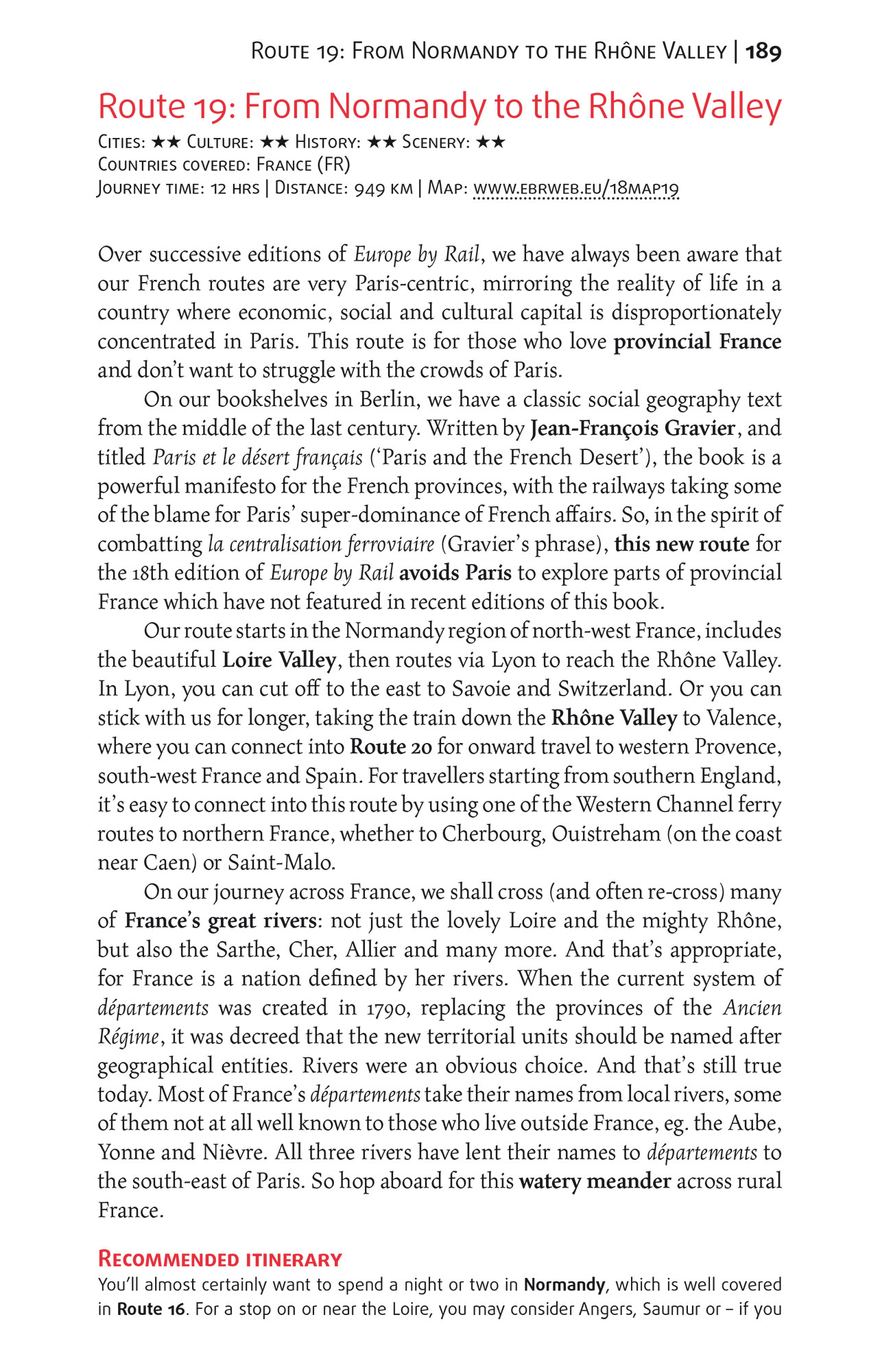
Cities: ** Culture: ** History: ** Scenery: **
Countries covered: France (FR)
Journey time: 12 hrs | Distance: 949 km
Over successive editions of Europe by Rail, we have always been aware that our French routes are very Paris-centric, mirroring the reality of life in a country where economic, social and cultural capital is disproportionately concentrated in Paris. This route is for those who love provincial France and don’t want to struggle with the crowds of Paris.
On our bookshelves in Berlin, we have a classic social geography text from the middle of the last century. Written by Jean-François Gravier, and titled Paris et le désert français (‘Paris and the French Desert’), the book is a powerful manifesto for the French provinces, with the railways taking some of the blame for Paris’ super-dominance of French affairs. So, in the spirit of combatting la centralisation ferroviaire (Gravier’s phrase), this new route for the 18th edition of Europe by Rail avoids Paris to explore parts of provincial France which have not featured in recent editions of this book.
Our route starts in the Normandy region of north-west France, includes the beautiful Loire Valley, then routes via Lyon to reach the Rhône Valley. In Lyon, you can cut off to the east to Savoie and Switzerland. Or you can stick with us for longer, taking the train down the Rhône Valley to Valence, where you can connect into Route 20 for onward travel to western Provence, south-west France and Spain. For travellers starting from southern England, it’s easy to connect into this route by using one of the Western Channel ferry routes to northern France, whether to Cherbourg, Ouistreham (on the coast near Caen) or Saint-Malo.
On our journey across France, we shall cross (and often re-cross) many of France’s great rivers: not just the lovely Loire and the mighty Rhône, but also the Sarthe, Cher, Allier and many more. And that’s appropriate, for France is a nation defined by her rivers. When the current system of départements was created in 1790, replacing the provinces of the Ancien Régime, it was decreed that the new territorial units should be named after geographical entities. Rivers were an obvious choice. And that’s still true today. Most of France’s départements take their names from local rivers, some of them not at all well known to those who live outside France, eg. the Aube, Yonne and Nièvre. All three rivers have lent their names to départements to the south-east of Paris. So hop aboard for this watery meander across rural France.
Source: from page 189 of the Routes Section in Europe by Rail (19th edition).
Cities: ** Culture: ** History: * Scenery: *
Countries covered: Poland (PL), Lithuania (LT ), Latvia (LV ), Estonia (EE), Finland (FI)
Journey time: 23 hrs 30 mins | Distance: 1,293 km
The great news for rail travellers is that from 2026 it becomes so much easier
to travel by train from Poland through Lithuania, Latvia and Estonia to
the shores of the Gulf of Finland. This new route for Europe by Rail requires
a minimum of three changes of train along the way, but the reinstatement
of key cross-border train connections very positively reshapes geography in
a region where international rail links were fragile or non-existent for many
years. Riga had a direct train to Vilnius restored in 2025, and since early 2026
there is once again a through train from Riga to Tallinn, so averting the
need to change trains at the Latvian-Estonian border.
Our rail journey from Warsaw runs north-east through a culturally
diverse region of rural Poland and then on through the three Baltic States –
a trinity of nations which are so often bundled together despite each having
its own distinctive language, culture and identity. Trains take us as far as
Tallinn, from where it is a short hop by boat across the Gulf of Finland to
Helsinki.
This route is a foretaste of what Rail Baltica promises for the future. Rail
Baltica is dedicated to the construction of a modern standard-gauge railway
from Warsaw to Tallinn, possibly even continuing through a tunnel to
Finland – but funding for that putative extension under the Gulf of Finland
is far from assured. At the moment, the great majority of trains in the three
Baltic States run on old Russian-gauge tracks but the Rail Baltica vision
promises a new electrified standard-gauge railway from Poland north
through Lithuania, Latvia and Estonia, cutting journey times by over fifty
per cent. Through passenger trains over the whole route from Warsaw to
Tallinn, taking less than seven hours, are not expected to operate before the
mid-2030s. But this is your chance to explore a beautiful part of Europe
by slower trains using the legacy Russian-gauge network, while getting a
glimpse of what Rail Baltica might offer in the next decade.
This route offers rich insights on geopolitical issues. Even the question
of the spacing of railway tracks (which in this book we often refer to as gauge)
is deeply political. Rail Baltica is not just about creating better rail links
between, for example, Riga and Vilnius or between Riga and Tallinn. It is as
much about freight and military logistics. Rail Baltica is thus part of a wider
effort by the European Union to secure strategic infrastructure which binds
the Baltic States closer to its EU partners by cementing economic, cultural and defence links between the Baltic region’s three ex-Soviet republics and
the wider community of western democracies.
Source: from page 297-98 of the Routes Section in Europe by Rail (19th edition).
Rail travel is generally very safe. But that was not the perception of Parisians in 1861 after poor Monsieur Poinsot was found dead in a railway carriage compartment at the Gare de l’Est. By the time Poinsot’s mutilated body was discovered, the murderer had long fled, presumably having alighted at one of the stations where the train from Mulhouse had stopped on its journey to Paris.
The fate of Monsieur Poinsot made French travellers think twice about buying a train ticket. Before long, Gallic panic over the dangers of train travel spread to England, when a particularly gruesome compartment murder took place in London. English trains were designed on the same lines as those in France, with first-class accommodation being in separate compartments, each accessed by a door directly from the railway platform. There was in those days no connection at all between adjacent compartments.
This design was the norm across Europe for first class, in contrast to North America where the open-plan saloon car was more common. Wolfgang Schivelbusch, in his marvellous book The Railway Journey, suggests that on European trains well-to-do travellers enjoyed the privacy and style associated with travel in a horse-drawn coach on a highway. The first-class railway compartment in Europe imitated the coach, but Schivelbusch notes that the design of the American railroad car was inspired by the open saloons on the riverboats which plied the young nation’s waterways.
“That only two cases of murder,” writes Schivelbusch, “were able to trigger a collective psychosis tells us as much about the compartment’s significance for the nineteenth century European psyche as does the fact that it took so long to become conscious of the compartment’s dysfunctionality.”
That dysfunctionality lay not merely in the compartment’s appeal for assassins. There were surely many instances of lavatorial distress; no surprise perhaps that, when a train arrived at an intermediate station after a particularly long non-stop leg, there was often a communal rush for the station toilets.
The victim in the London murder was an unfortunate Mr Briggs; his assailant was a German villain named Franz Müller. The railways responded by introducing a small glazed peephole between compartments. These peepholes were called Müller Lights. Many a courting couple surely bemoaned the resulting loss of privacy. Before long, railway companies installed communication cords which passengers in distress could pull to alert the train crew to an emergency. But a German railway engineer, Edmund Heusinger von Waldegg, devised a more radical approach to mitigating the dangers of travel in compartments. He suggested an internal corridor down one side of each carriage, allowing passengers and train staff to move from compartment to compartment. It did not entirely erode the intimacy of the small compartment but now afforded a new sense of safety and security. It also paved the way for the introduction of on-board facilities such as toilets and restaurant cars.
European carriage design has moved on, with the open-plan saloon now much preferred by most travellers. Trains with individual compartments linked by a connecting corridor are now increasingly rare. Read more on carriage design in Sidetracks 0 (on communal carriages in Russia) on p287.
Source: from page 175 of the Routes Section in Europe by Rail (19th edition).